A lean public site and a gated pitch deck
The public page tells the brand story. The operating model sits behind a password on a partners subdomain. I traded some persuasion on the open page for protecting how the business works.
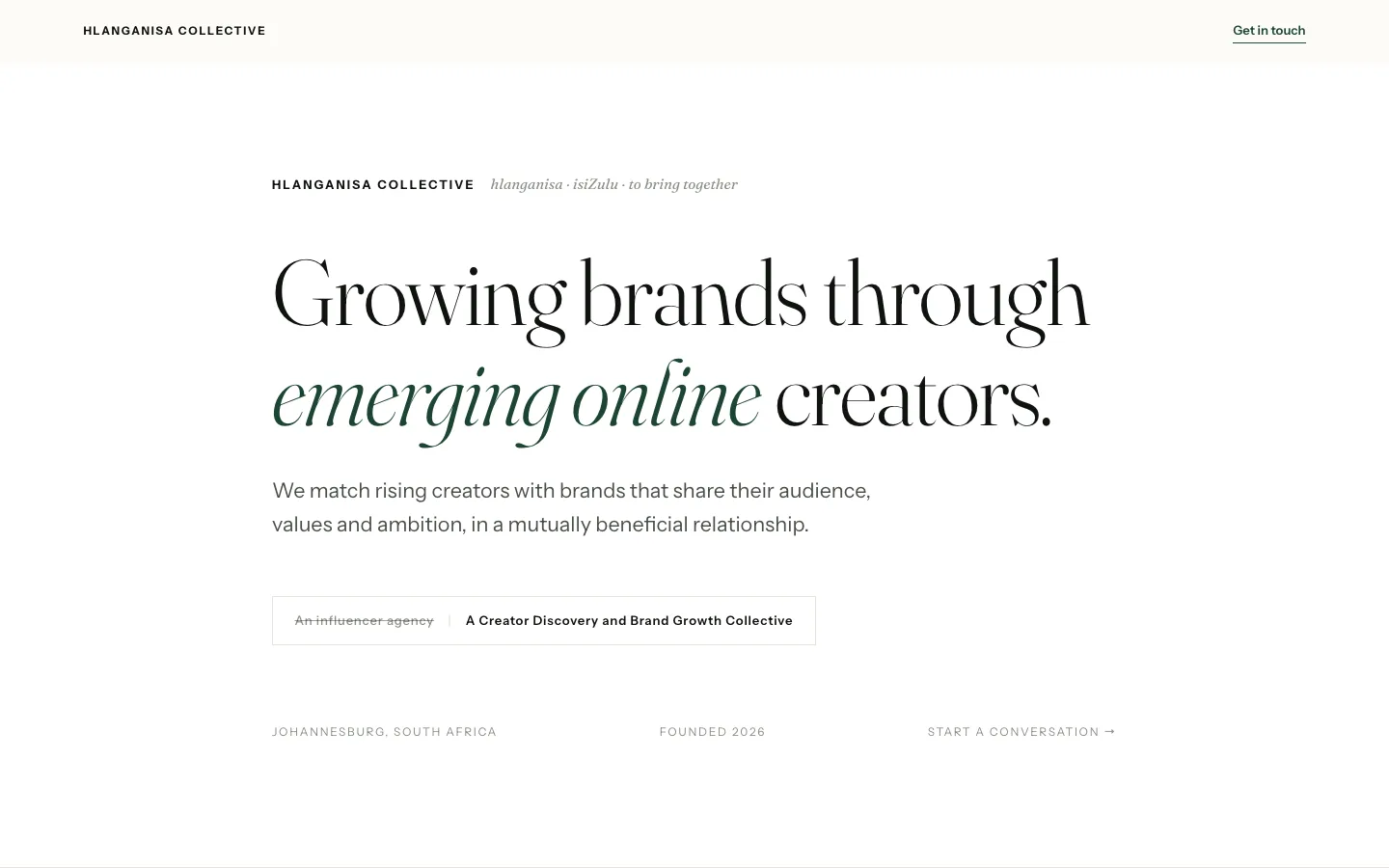
Hlanganisa Collective is a company I co-founded to match emerging South African creators with brands that share their audience and values. I designed and built the whole digital product: the brand and editorial system, the public site, the creator intake, a passwordless member area that teaches, and the measurement behind it.
The brief was to be credible on day one with no existing audience and no agency budget. The result is a live platform where 65 creators signed up through the form in four days. It has no measured brand outcomes yet, and this page does not claim any.
The homepage leads with the promise, then a Quick Facts block and a FAQ so both people and answer engines get the basics quickly. The operating detail stays behind the gate.
The editorial system is deliberately quiet: a high-contrast serif for voice, a clean sans for reading, and forest green used sparingly.
Most visits landed on the creator form, so it was redesigned as four short steps with a live profile card that takes shape as creators answer. A No joining fee panel sits in the Quick Facts.
A brand and creator page at /connect gives each audience a clear door.
The sign-in and join pages were forms and text. I added a young South African creator to each, in the same warm, green-toned style as the rest of the site: a woman checking her profile on sign-in, a man about to film his first video on join. A short silent loop plays over each photo. On phones the photo sits above the form so the form is never covered, and visitors who ask for reduced motion or data saving keep the still.
I designed both in Figma for desktop and phone, got approval, then built and deployed them the same day. The photos and loops are AI-generated and art directed, not photographs of real people. The loops are 204 KB and 289 KB. Page speed and signup effect have not been measured, so no result is claimed.
Creators sign in with an emailed link, build a profile with a strength score, learn short lessons and, once matched, see briefs that fit. Photo upload has a crop and zoom dialog and a two-letter fallback.
The screens below are the final Figma frames, using sample content and a fictional creator.
Each lesson has objectives, key terms, numbered sections, tables, colour-coded templates, figure plates with numbered callouts, a summary and review questions. A floating contents panel tracks reading position.
The first diagrams were too simple, so the plates were rebuilt as near-realistic illustrations. They are generated with image models and art directed, then checked against their callout positions.
Quick checks explain why an answer is right. An ordering challenge teaches the structure of a pitch. XP, five levels, a streak and badges give progress a shape, and opportunities stay locked until a creator is matched.
Quiz answers and lesson copy are sample content in these frames and still await founder proofreading.
The announcement was designed at 600px and 390px, sent as HTML with a plain text version, and written in the brand voice: plain, warm and exact, with no fee wording and the next step stated.
Nineteen colour variables carry their CSS names as code syntax, with ten text styles alongside. The board also records voice rules and a logo handover checklist, because the logo is provisional.
The public page tells the brand story. The operating model sits behind a password on a partners subdomain. I traded some persuasion on the open page for protecting how the business works.
Creator details live in a Cloudflare D1 database behind a Worker. It cost build time, and it gave full control of consent, retention and deletion, which matters under POPIA.
GA4 showed 44 users on the creator page while the database held 65 signups. Consent is denied by default and blockers hide visitors, so I measure from the database and report GA4 as a minimum.
Creators arrive on phones. A sign-in link by email removes a password to forget, at the cost of depending on email delivery, which I set up and verified first. A provider limit later proved how much that dependency matters.
Sending the member-area announcement used up the email provider free daily limit, which also blocks sign-in links until it resets. I capped automatic sends at 30 per rolling 24 hours and stopped sending on the first limit error. The cap protects sign-in, and the plan upgrade is a founder decision.
The two entry pages were forms and text. I gave each a generated photo of a young South African creator in the site's warm green style, with a short silent loop over it, because there was no photography budget. The loops are about 200 to 290 KB and play only when the visitor has not asked for reduced motion or data saving. The cost is that generated people need a close check and honest disclosure, which this page gives.
Lessons, XP and streaks keep creators returning, while opportunities stay locked until a creator is matched. A premium tier was proposed and parked because it conflicts with the decision not to charge creators.
Partner deck drafted, then rebuilt as a premium editorial direction in Fraunces and Instrument Sans. Cinemagraph loops and imagery produced.
Domain live on Vercel with HTTPS. A planned DNS migration stalled, so launch stayed on the existing DNS rather than waiting.
Two real mailboxes on Zoho with SPF, DKIM and DMARC after earlier routing plans were abandoned.
Public homepage with Quick Facts and FAQ schema. Deck moved behind a gate. A routing bug and a mobile layout bug found and fixed the same day.
Worker, database and email built and tested with a real submission. The form was redesigned to four steps on 19 Oct. 28 creators signed up that day.
Passwordless member area, learn hub, profile photo with crop and zoom, a /connect page for brands, and the traffic review that moved measurement to the database.
Lessons rebuilt as illustrated textbook chapters, then XP, levels, streaks, badges, quizzes and ordering challenges, a motion layer, and an interactive profile checklist, all deployed.
An HTML newsletter with a plain text version went to more than 100 creators in batches, with no fee wording by decision. An automatic version now follows each new signup.
The free email limit was reached during the send. Automatic sends are now capped and stop on the first limit error, and an upgrade is recommended before the next signup push.
Designed in Figma for desktop and phone, approved, then built and deployed the same day. A generated creator photo and a silent loop on each page, a main landmark added to sign-in, and image and video structured data on join. 1155 automated tests passed.
Turned a pitch into four connected surfaces: public site, creator intake, member area and a brand enquiry route. Redesigned the intake as a four-step form with a live profile card after the data showed it was the real front door.
One editorial system carried from deck to site to member area. Explored three member-area directions in Figma, then rebuilt the chosen one in code.
Hand-built, dependency-light pages with balanced headlines, mobile passes at phone widths, and an accessible FAQ.
Cloudflare Worker with a 17-table D1 schema, passwordless sign-in, XP and streak tracking, photo upload with crop and zoom, self-service data export and deletion.
Nine textbook-style lessons with objectives, key terms, tables, figure plates, quizzes, ordering challenges, XP, levels, streaks and badges. Referenced Mindvalley, WHOOP, Uxcel and NYT Games, and kept the gamification away from the matching flow.
A motion layer with staggered page rise, ring draw and count-up, and a burst when a lesson is done, with a reduced-motion switch.
Consent Mode with analytics denied by default, a privacy notice, and a finding that analytics undercounted signups, which moved measurement to the database.
Quick Facts, FAQ with FAQPage schema and Organization schema on the homepage and the creator and brand pages.
A Creator Discovery and Brand Growth Collective in Johannesburg, South Africa, founded in 2026. It is not a traditional influencer agency.
I co-founded it and was the designer-builder: brand system, UX and UI, front-end, the Cloudflare Worker and database, email, analytics and consent.
Yes. The public site has been live at hlanganisacollective.co.za since 20 July 2026, creator intake since 14 October 2026, and the learn hub since 21 October 2026.
HTML, CSS and JavaScript on Vercel, with a Cloudflare Worker, a D1 database and Resend for email. Analytics runs through GA4 and Tag Manager behind Consent Mode.
65 creators signed up through the form between 17 and 20 October 2026, with 28 on 19 October. Brand-side results are not yet measured.
Analytics is denied by default and blockers hide visitors. GA4 recorded 44 users on the creator page while the database held 65 signups.
Details sit in a database the founders control. Creators consent at signup and can export or delete their data from the member area.
Nine short lessons on profile, shooting, sound, editing, pitching, pricing, contracts, labelling and staying safe, with figure plates, quizzes, ordering challenges, XP, levels and streaks.
Each shows a generated photo of a young South African creator with a short silent loop over it. On phones the photo sits above the form. Visitors who ask for reduced motion or data saving see the still photo. The photos and loops are AI-generated, not photographs of real people.
Sending the announcement used up the email provider free daily limit, which can also block sign-in links. Automatic sends are now capped at 30 per rolling 24 hours, and a plan upgrade is recommended.
Yes. Product design, UX and UI, design systems, web build and measurement are available through Clekzo Studio. Use the enquiry button on this page.
If you are hiring for a senior product design role, or need a studio partner who can take a product from brand through build and measurement, tell me what you are working on.
If you are hiring for a senior product design role or need a designer who can shape complex product work from strategy through interface detail, get in touch.
Discuss a role